

Organizing a drone show in an urban environment imposes certain technical, regulatory and logistical constraints. Stellair’s know-how enables you to turn these specific constraints into opportunities. We’ll tell you all about it.
A stronger urban regulatory context
The administrative aspect is the first challenge to be overcome when setting up a drone show in an urban environment. Aviation regulations impose restrictions, with most city centers located in restricted zones or close to airfields requiring authorization. At the same time, the number of prohibited overflight zones in cities is increasing, ranging from sensitive buildings to establishments open to the public, critical infrastructures and residential areas. The mapping of these exclusions determines the choice of site and trajectory.
Maximum flight heights are generally more restrictive in urban environments, to avoid interference with air traffic and minimize disruption to local residents. Authorized time slots take potential noise pollution into account, even though drones are relatively quiet.
What are the technical constraints in dense urban environments?
The density of transmitting equipment (telecoms antennas, Wi-Fi networks, industrial equipment and electrical installations) creates significant electromagnetic noise that can disrupt communications with drones. In addition, the presence of vertical obstacles complicates trajectory planning and reduces usable airspace. Buildings, monuments, cranes and other structures need to be integrated into flight planning.
Urban lighting is also likely to affect the visibility and impact of the show’s lighting effects. Street lighting, commercial signs, illuminated facades and light pollution in general create visual competition that needs to be taken into account. All these constraints call for adaptation and expertise.
Logistical challenges
Access to urban sites poses challenges in terms of transport and equipment delivery. Traffic restrictions, pedestrian zones and delivery time slots require precise coordination with municipal services. Transporting dozens of UAVs and related equipment requires several vehicles and meticulous organization to meet these constraints. The space available for technical installation is often limited in urban environments. Take-off and landing zones, as well as control stations, have to fit into this constrained environment.
Last but not least, spectator flow management. This involves planning access routes, assembly areas, evacuation routes and safety systems according to the site’s capacity.
When the urban environment becomes a source of creativity
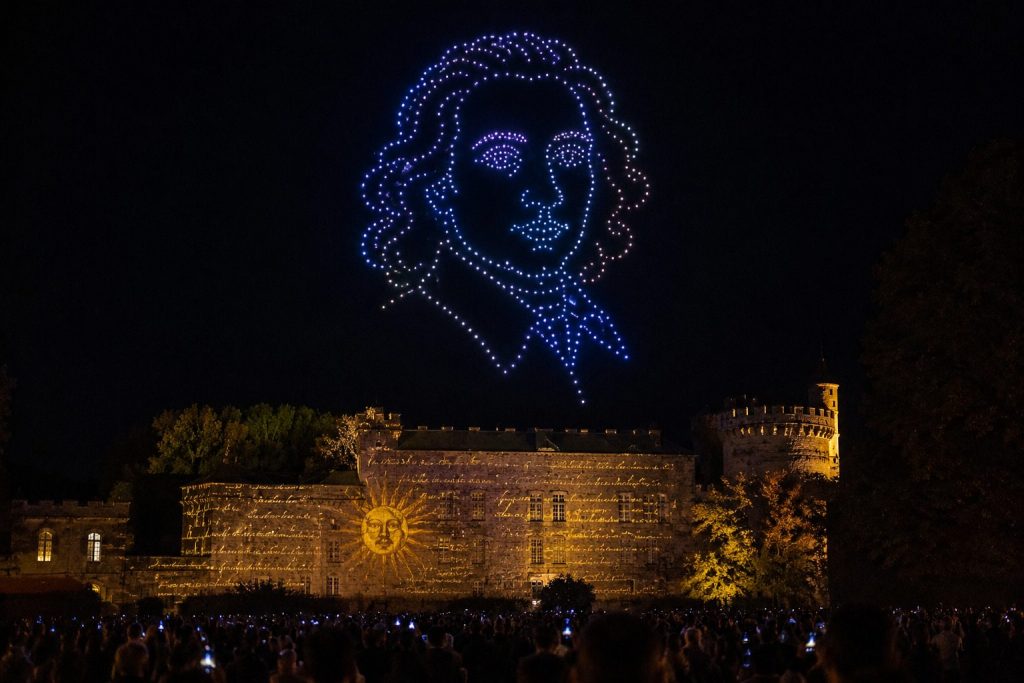
Having discussed the constraints of the urban environment, let’s turn our attention to the opportunities that serve the potential of the drone show. Monuments can become integral elements of the show, serving as visual anchors or narrative supports. Drones can virtually surround or extend architecture, and facades can serve as projection screens. Urban topography offers a panoply of perspectives that enrich the experience. Unlike flat sites where the audience follows the show from the same angle, the urban environment can offer differentiated viewpoints depending on streets, squares or roof tops.
Urban identity has always been an inspiration. In the case of drone shows, it allows for tailor-made creations with references to local heritage, city symbols, historical events or cultural specialties. What’s more, these animations are rarely isolated events, but form an integral part of more complete (and complex) event ecosystems.
You can also link the event to other urban elements, such as lighting. Christmas markets, summer concerts and other parallel activities create an event offering that builds public loyalty in the city. Showcasing public spaces enhances their appeal and visitor numbers. The squares, parks and quays that host the show benefit from an illumination (literally and figuratively) that can transform their perception and use.
Managing risks specific to the urban environment
As already mentioned, urban density and the proximity of the public call for a rigorous approach to risk management, with reinforced safety protocols. Buffer zones, physically marked out or monitored by security guards, ensure that no drone in difficulty can reach spectators or damage buildings. Emergency procedures adapt to urban complexity, with evacuation plans and coordination with emergency services. The fire department, medical services and police must be informed of the show’s progress and potential risks. Crisis communication prepared in advance enables us to react quickly and effectively in the event of an incident. Communication protocols with the public, media and authorities are predefined to avoid panic reactions and maintain confidence in the safety of the event.
The success of a drone show in an urban environment also depends on its acceptability to local residents, hence the need for a communication and consultation strategy. This approach also helps to reinforce ownership of the project. Don’t forget that the economic and symbolic benefits of the project may justify some temporary inconveniences. The important thing is to emphasize the collective benefits: the city’s influence, tourist appeal, local pride…. Some shopkeepers, schools, cultural associations and tourism operators can even be involved in running the event to ensure that it takes root.
Tomorrow’s show: technological innovations for the urban environment
As is often the case, constraints stimulate innovation and the development of solutions that push back the limits of what is possible. In the case of drone shows in urban environments, navigation systems incorporate sensors and algorithms designed to maintain positioning accuracy despite disturbances. Drones are protected against electromagnetic interference. Design support tools accelerate project development, with communication systems capable of selecting the best frequencies and adjusting their parameters in real time to maintain optimal links. Adaptability remains a major challenge for show reliability in urban environments.
Stellair has developed unique expertise in the design and production of drone shows in urban environments. Our approach integrates all the technical, regulatory and creative aspects associated with this environment. Our knowledge of the relevant regulations will make it easier for you to obtain the necessary authorizations. Want to illuminate a historic square? Organize a community event to honor a special occasion? Or highlight a new tourist attraction? Contact us: we’ve got the solution!